

Importing food commercially into Great Britain is not one process. The route changes with the commodity code, ingredients, processing method, intended use, country of origin and current safeguards. Frozen chicken, canned tuna, ground spices, mangoes and shelf-stable cheese crackers may arrive in the same container, but they do not follow the same regulatory pathway.
This guide applies to imports from countries outside the European Union into England, Scotland and Wales. It does not cover Northern Ireland, personal imports, live animals or goods moving under special Northern Ireland arrangements. It reflects official guidance available on 15 June 2026, but dynamic controls must be checked again before every shipment.
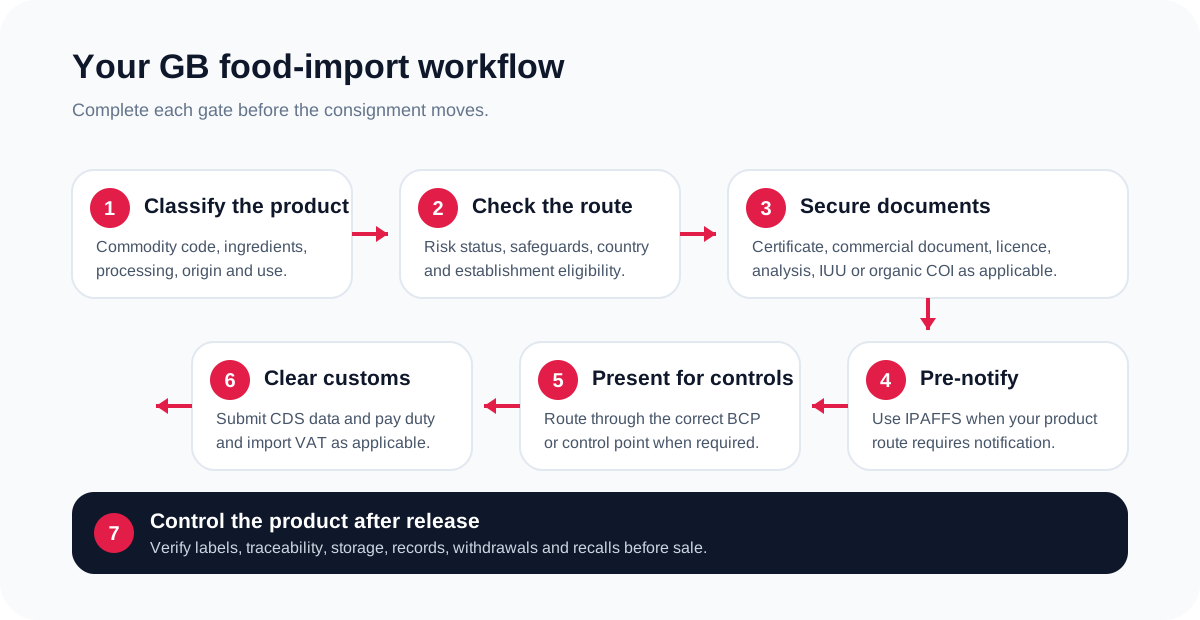
1. Define the product before choosing the import route
Start with a complete specification from the manufacturer. A sales description such as “protein snack”, “seasoning” or “ready meal” is not enough. Record:
- the UK commodity code;
- the full ingredient list and percentage of each animal-origin ingredient;
- the manufacturing and heat-treatment process;
- whether the product is chilled, frozen or shelf-stable;
- whether it is for human consumption, animal feed or another use;
- the country of origin, country of manufacture and country of dispatch;
- the manufacturer, processor, cold store and other relevant establishments;
- whether it will be marketed as organic; and
- for fish, whether it is wild-caught or aquaculture and where it was caught, processed and stored.
Use the UK Trade Tariff to identify the commodity code. If classification remains uncertain, obtain specialist customs advice or consider applying to HMRC for an Advance Tariff Ruling. The code affects customs duty, but it also helps determine which sanitary, phytosanitary and documentary controls apply.
2. Identify every regulatory route that applies
A product can sit under more than one control regime. Organic fish, for example, may need the fishery POAO route, illegal fishing documentation and organic certification. A mixed consignment containing HRFNAO and animal products may need separate notifications and document references.
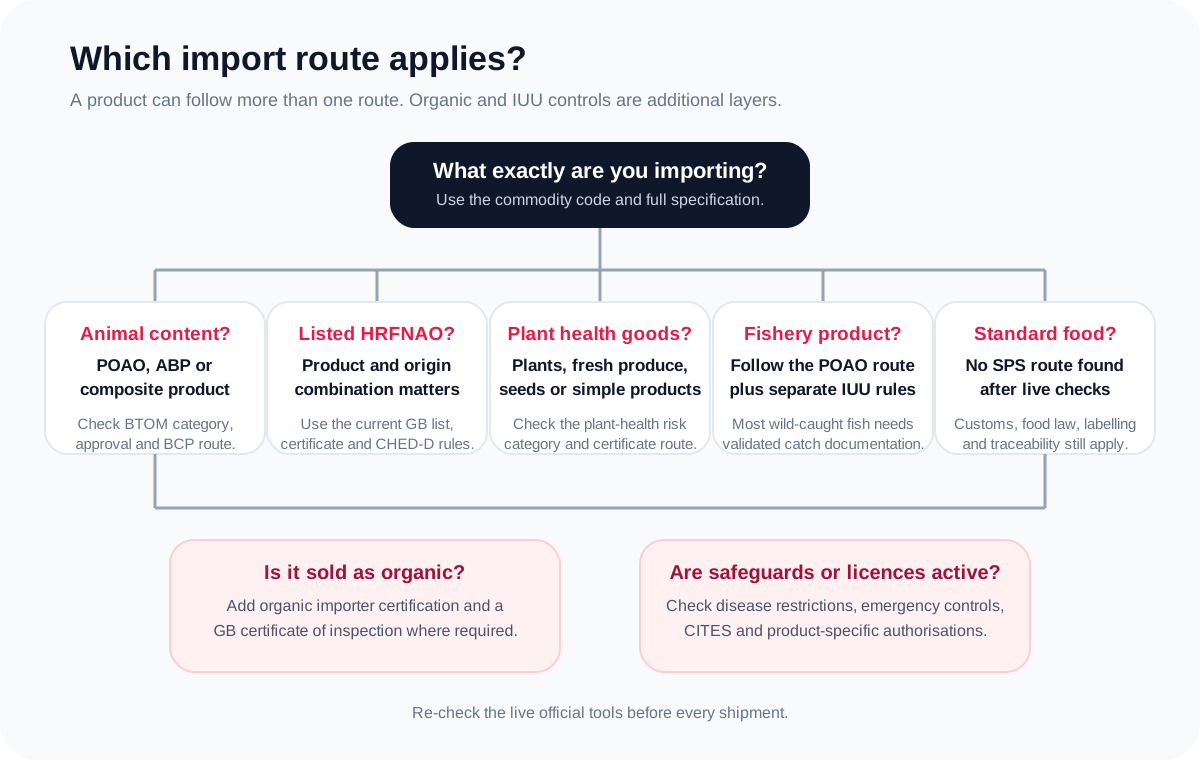
Products of animal origin and animal by-products
For non-EU origins that Defra has risk assessed, products of animal origin (POAO), animal by-products (ABP), germinal products and live animals are categorised as low, medium or high risk under the Border Target Operating Model. These categories only apply to non-EU countries that Defra has risk assessed. If an exporting country has market access but is not on the assessed-country list, follow the existing import process and product-specific conditions instead of assigning a BTOM risk category.
- Medium and high risk: normally require a health certificate, or an importer declaration where one is available, plus IPAFFS pre-notification and the applicable border controls.
- Low risk POAO and ABP: normally travel with a supplier commercial document rather than a health certificate, but they must still meet the relevant import conditions. Official GOV.UK guidance states that low-risk consignments from non-EU countries must enter through a relevant Border Control Post, although they may not receive routine identity or physical checks.
Use the current non-EU animal-product risk categories. Do not reuse a category from a similar product or an earlier shipment.
Composite and compound products
A composite product combines processed animal-origin products with plant products that are integral to the final food, such as a lasagne containing processed meat, sauce and pasta. A compound product contains more than one animal-origin product, which may be processed or unprocessed. The route depends on the ingredients, treatments and storage conditions.
Obtain a quantitative recipe and process description before classifying a mixed food. “Shelf-stable” does not automatically mean exempt, and a single-ingredient fish product does not become composite merely because it is canned.
High-risk food and feed of non-animal origin
High-risk food and feed of non-animal origin (HRFNAO) is not part of the BTOM high, medium and low animal-product categorisation. It is controlled through product-and-origin listings and emergency measures. Requirements can include laboratory results, an official certificate, a commercial document, IPAFFS pre-notification using a CHED-D and entry through an appropriately designated BCP.
Check the live FSA HRFNAO guidance for the exact product-country combination. A spice from one origin may be listed while the same spice from another origin is not.
Plants and plant products
Plants and plant products use a separate plant-health model: high risk, medium risk A, medium risk B and low risk. High-risk and medium-risk A or B goods are subject to plant-health conditions; low-risk goods are exempt from plant-health controls. The requirements differ between categories.
For example, high-risk and medium-risk A goods require importer registration, a phytosanitary certificate, notification through IPAFFS and applicable checks. Medium-risk B goods require a phytosanitary certificate but do not follow the same notification and inspection steps. Check the live category on the Plant Health Portal.
Fishery products
Fishery products for human consumption are generally POAO and follow the relevant BTOM route. Illegal, unreported and unregulated fishing controls are a separate layer. GOV.UK states that most fish imported into the UK requires a validated catch certificate from the competent authority of the country where the catching vessel is registered or licensed.
If fish was processed or stored in another country, an endorsed processing statement or proof of storage may also be required. These IUU documents have their own advance-submission deadlines and apply independently of the product's BTOM category. Do not assume canned tuna is exempt: confirm the species, commodity code, catch method and processing chain using the current fish import guidance.
Organic food
Organic status does not replace the ordinary import route. The food must first comply with the POAO, plant, HRFNAO or standard-food requirements that apply to it.
To import organic food from outside the EU, EEA and Switzerland into Great Britain, the importing company must be UK-based and certified by an approved UK organic control body. Each consignment needs a Great Britain certificate of inspection (COI), and the exporter’s control body and country or territory of export must appear on the relevant registers. The COI is issued by the exporter’s control body in the country of export.
Standard food not subject to SPS import controls
Many processed foods of non-animal origin are not HRFNAO and are not controlled plant products. They may not require an SPS certificate, IPAFFS notification or BCP presentation. Customs, food safety, composition, contaminants, labelling, traceability and recall duties still apply.
Do not label a product “standard low risk” until you have checked the commodity code, ingredient specification, current HRFNAO listings, plant-health status and safeguards.
3. Verify country, territory and establishment eligibility
POAO and ABP can only enter Great Britain from approved countries or territories. Some products must also come from establishments approved to export that commodity to Great Britain. Depending on the product, relevant sites can include slaughterhouses, cutting plants, processing establishments, cold stores, factory vessels and production plants.
Check the current GB approved-country and establishment information. Approval to export to the EU, the United States or another market does not by itself prove GB eligibility.
Then check current disease restrictions, safeguard measures and product-specific bans. Eligibility can change between order and dispatch. Put a final regulatory re-check into your dispatch-release procedure.
4. Set up the GB importer
Before the first shipment, establish who is responsible for each customs and SPS action. Common preparations include:
- GB EORI: normally required for a business making customs declarations in Great Britain.
- IPAFFS access: required when the applicable route calls for import pre-notification.
- Food-business registration or approval: register relevant premises with the competent local authority, normally at least 28 days before starting food operations. Activities involving certain POAO may require approval rather than registration.
- Plant professional-operator registration: achieved through IPAFFS registration for first-time importers of high-risk or medium-risk A plants and plant products; timber routes may involve the Forestry Commission.
- Organic certification: required if importing organic goods.
- Customs and VAT arrangements: decide who submits the declaration, how import VAT and duty will be accounted for, and whether any preference or tariff quota will be claimed. VAT registration is not a universal prerequisite for every importer; obtain tax advice for your circumstances.
An agent can submit customs or IPAFFS data, but the contract must state whether the agent is acting directly or indirectly and who supplies and checks each data element. Outsourcing data entry does not remove the food business's responsibility to ensure the goods can legally be imported and marketed.
5. Obtain the right certificates and evidence
| Document | Typical use | Critical check |
|---|---|---|
| Export health or official certificate | Medium- and high-risk animal products and specified controlled foods | Use the current GB model and confirm every page, statement, signature and establishment number. |
| Commercial document | Low-risk POAO or ABP and general shipment evidence | It must contain the route-specific particulars and travel with the consignment where required. |
| Laboratory results | Specified HRFNAO and emergency controls | Check the analyte, sampling method, laboratory and validity requirements in the current measure. |
| Phytosanitary certificate | High-risk and medium-risk A or B plants and plant products | The exporter obtains it from the plant-health authority and the issue timing must meet GB rules. |
| IUU documents | Most wild-caught fish and fishery products | Validate the catch certificate and add processing or storage evidence where the chain requires it. |
| GB certificate of inspection | Organic goods from outside the EU, EEA and Switzerland | The exporter’s recognised control body issues the COI for the consignment. |
| Licence or authorisation | Products without a suitable certificate route or subject to special controls | Confirm conditions, validity and whether the document must accompany the goods. |
Ask for draft certificates before loading. Compare the description, weights, package count, seal, transport details, origin, destination and establishment numbers against the commercial documents. Corrections are much easier before certification and dispatch.
6. Pre-notify through IPAFFS when required
Use IPAFFS for the regulated routes identified by the official guidance. For non-EU POAO subject to veterinary checks, ABP subject to veterinary checks and HRFNAO, the general notification deadline is at least one working day before arrival at the point of entry. Plant-health deadlines differ: current guidance states at least four working hours before arrival for air and roll-on/roll-off freight, and at least one working day for other freight, for high-risk and medium-risk A plants and plant products.
Do not convert those examples into one company-wide deadline. Build the notification deadline from the actual product route, port and mode of transport, and check whether the BCP requires earlier operational notice.
The notification must match the certificate and customs declaration. Where a product contains separately controlled commodity types, separate CHED notifications may be required. The relevant CHED references must then be entered correctly in the customs declaration.
7. Route the goods through the correct point of entry
Before booking freight, confirm that the point of entry has a BCP designated for the exact commodity. A port approved for packaged products for human consumption may not be approved for live animals, ABP, plants or every temperature regime.
Animal-product consignments from non-EU countries, including low-risk consignments covered by the current guidance, must use the relevant BCP route. High-risk and medium-risk A plants must enter through a port or airport with a plant BCP, even where an authorised inland control point will carry out selected checks. HRFNAO must use the designated entry route specified for those controls.
Budget for port-health, APHA, local-authority, storage, handling, sampling and common-user charges where applicable. Ask the BCP for its current tariff and operating procedure before agreeing the freight route.
8. Coordinate SPS and customs clearance
SPS controls and customs controls are separate, but the systems exchange references and release information. Submit accurate customs data through the Customs Declaration Service, including the relevant document codes and CHED references. Account for duty, import VAT, preference claims, quotas and licences as applicable.
Do not instruct the haulier to leave the BCP or customs-control area until the competent authority has completed the required decision and the goods have customs permission to proceed. For controlled animal goods, the validated CHED records the border-control outcome.
9. Apply post-import food controls
Border release does not prove that the product is ready for sale. Before distribution, verify:
- GB food-information and importer-address requirements;
- ingredient, allergen, nutrition, date-marking and storage statements;
- product-specific composition or marketing standards;
- temperature and packaging integrity;
- lot identification and one-step-back/one-step-forward traceability;
- supplier and imported-product approval within your HACCP or food-safety system;
- sampling or positive-release controls required by your risk assessment; and
- a tested withdrawal and recall procedure.
Keep certificates, notifications, CHED decisions, customs records, specifications, transport records and corrective actions for the periods required by the law applying to each record and by your documented traceability system. There is no single two-year retention rule that safely covers every food and customs record.
10. Worked classification examples
Frozen chicken from Brazil
This is POAO. Confirm the exact commodity code, current BTOM category, Brazil's eligibility for that commodity, establishment approval, the current GB health-certificate model, IPAFFS requirements and a BCP designated for the product. Check disease safeguards immediately before certification and dispatch.
Canned tuna from Thailand
Canned tuna is a processed fishery product and POAO, not a composite product merely because it is canned. Check its BTOM category and SPS documents. Separately establish whether a validated catch certificate, processing statement or proof of storage is required. The fish guidance states that most fish requires IUU documentation, including where processing occurred in a country different from the vessel's flag state.
Ground spices from India
Start with the exact spice, commodity code and origin. Check whether that product-country combination is listed under HRFNAO or another emergency measure. If listed, follow the specified certificate, analysis, CHED-D and BCP route. If not listed, check for other safeguards before treating it as standard food.
Fresh mangoes from Pakistan
Use the Plant Health Portal to identify the live plant-health category and any pest-specific conditions. The category determines whether importer registration, a phytosanitary certificate, IPAFFS pre-notification and inspection apply. Also check fruit-and-vegetable marketing standards.
Shelf-stable cheese crackers from the United States
Obtain the recipe and manufacturing process, then determine whether it meets the legal definition and conditions for a composite product. Check the dairy ingredients, treatment, shelf stability, country and establishment conditions and the current risk category. Do not assume that shelf stability removes every import requirement.
11. What happens when a consignment fails
A competent authority can detain goods while it checks documents, identity, physical condition or test results. Depending on the legal route and the defect, the final outcome may include re-dispatch, destruction, treatment or another authorised use. The importer normally carries the commercial consequences, including storage, demurrage, transport, official supervision and disposal.
If a certificate error is discovered, contact the BCP immediately. Do not alter an official certificate yourself. Maintain a written incident record and assess whether other consignments, suppliers or products are affected.
12. First-import checklist
Before ordering
- Confirm the commodity code and complete specification.
- Map every applicable regime: animal product, composite, HRFNAO, plant health, fish/IUU, organic, CITES or safeguards.
- Check country, territory and establishment eligibility.
- Confirm that the exporter can obtain the current certificate and supporting evidence.
- Set up EORI, IPAFFS, premises registration and specialist registrations as applicable.
- Agree Incoterms and allocate certification, BCP, sampling, demurrage and rejection costs.
Before dispatch
- Re-check risk categories, listings, disease restrictions and safeguards.
- Review draft certificates against the invoice and packing list.
- Confirm the BCP designation and operating hours.
- Book a customs and logistics provider experienced with the exact commodity.
Before arrival
- Submit each required IPAFFS notification within the correct deadline.
- Provide IUU documents to the relevant authority within their separate deadline.
- Enter all certificate and CHED references correctly on customs data.
- Monitor changes to arrival time and amend notifications where required.
After release
- Check the goods, seal, temperature, lot codes and quantities against the documents.
- Complete the label and product-compliance review before sale.
- Store the import file in an auditable traceability system.
- Review supplier and shipment performance before the next order.
Official sources to check for every shipment
- Non-EU animal products and HRFNAO import guidance
- IPAFFS guidance
- Fish and IUU import guidance
- Non-EU plant import guidance
- Organic import guidance
- FSA HRFNAO guidance
- UK Trade Tariff
Next step
- Read next: How to export food from Great Britain to the EU
- Use this template: Traceability log template
- Create a free account: Organise import records, control checks, and border documents in one working place.
Hero photograph: Thomas Parker on Pexels.